
Can pre diabetics eat açaí bowls?
If you’re trying to manage your blood sugar, it’s normal to wonder whether açaí bowls are still an option.
The answer isn’t as simple as yes or no because not all açaí products are made the same.
Many commercial açaí products sold in Australia and New Zealand contain added sugar. The same applies to several products within the Tropical Brazil range, where demerara sugar is used as part of the recipe. While this helps create the flavour profile many customers expect, it also means those products may not be suitable for everyone.
For consumers looking for an alternative without added sugar, Tropical Brazil also offers Açaí Zero. Even then, people living with prediabetes or diabetes should discuss dietary choices with their healthcare professional or dietitian, as individual recommendations can vary significantly.

The Biggest Mistake People Make
One of the most common misconceptions is assuming that every açaí bowl is healthy simply because it contains açaí.
In reality, the ingredients added to the bowl often make a bigger difference than the açaí itself.
A standard bowl may include sweetened granola, honey, chocolate syrup, condensed milk, fruit concentrates or guaraná-based syrups. By the time all those ingredients are added together, the sugar content can be very different from what many consumers expect.
That’s why looking at the entire bowl matters more than focusing on a single ingredient.
Why Ingredient Labels Matter
Walk into ten different cafés and order ten different açaí bowls, and there’s a good chance you’ll receive ten completely different products.
Some use sweetened açaí blends.
Some use unsweetened bases.
Some add syrups before the bowl even reaches the customer.
Others allow customers to build their own combinations from scratch.
Without checking ingredients, it’s almost impossible to know exactly what you’re eating.
That’s particularly important for people who are already monitoring carbohydrate and sugar intake as part of a broader dietary plan.
What About Prediabetes?
Prediabetes does not automatically mean a person must completely avoid açaí.
However, the overall composition of the meal remains important.
The amount consumed, the toppings selected and the individual’s blood glucose management plan all play a role in determining whether an açaí bowl is an appropriate choice.
For some people, occasional consumption in moderate portions may fit within a balanced eating pattern.
For others, different dietary recommendations may apply.
This is why personalised advice is always recommended.
A Lower Sugar Alternative: Açaí Zero
For consumers looking to reduce their intake of added sugars, Tropical Brazil also offers Açaí Zero.
Unlike many commercial açaí products, Açaí Zero contains no added sugar.
This allows cafés, restaurants and consumers to build bowls and smoothies with greater control over the final sugar content of the meal.
However, it is important to remember that no single food can be considered universally suitable for everyone.
Even products without added sugar should be consumed according to individual nutritional needs and professional dietary advice.
Regular Açaí and Açaí Zero Are Not the Same Product
This is where many consumers become confused.
Açaí Zero was developed for customers who want a product without added sugar.
That doesn’t automatically make it the right choice for every person, but it does give cafés, restaurants and consumers more control over what goes into the final bowl.
By starting with a base that contains no added sugar, it’s easier to make decisions about toppings and portion sizes without adding sweetness before the bowl is even assembled.
Toppings Matter More Than Most People Think
The toppings are usually where things can change quickly.
Ingredients such as honey, condensed milk, chocolate sauces and sweetened granola can dramatically increase the sugar content of a bowl.
On the other hand, many people choose ingredients such as berries, seeds, nuts or unsweetened coconut flakes when they’re looking for a lower-sugar option.
The difference between two bowls can be substantial, even when both start with the same açaí base.
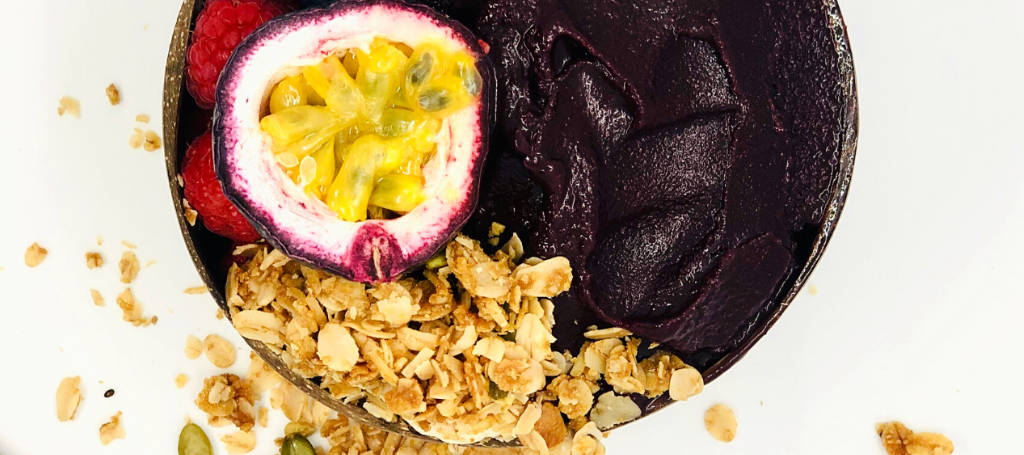
Can People with Diabetes Eat Açaí?
For some people, the answer may be yes.
For others, the answer may be no.
The deciding factor isn’t the word “açaí” on the menu. It’s the product being used, the ingredients added to it, the portion size and the nutritional guidance being followed by that individual.
What can be said with certainty is that not all açaí products are equal.
Some contain added sugar.
Some don’t.
Some bowls are built like a light snack.
Others are closer to a dessert.
Understanding that difference is far more useful than assuming every açaí bowl belongs in the same category.
If you’re managing prediabetes or diabetes, knowing exactly what’s in the bowl is always a better starting point than relying on marketing claims or assumptions.
- Does açaí help lower blood sugar?
The information regarding açaí’s impact on blood sugar is drawn from peer-reviewed human clinical trials, systematic reviews on berry polyphenols, and standardized glycemic testing.
The primary scientific sources breaking down these specific claims include:
1. Human Clinical Data on Fasting Glucose & Insulin Sensitivity
The Study: “Effects of Açai (Euterpe oleracea Mart.) berry preparation on metabolic parameters in a healthy overweight population: A pilot study” (Published in Nutrition Journal / PubMed).
What it found: This clinical trial gave overweight adults 100g of unsweetened açaí pulp twice daily for 30 days. It found significant reductions in fasting glucose and fasting insulin levels compared to baseline. It also showed that açaí significantly blunted the post-meal blood sugar spike (measured via the glucose area-under-the-curve) after a standardized meal.
2. Glycemic Index Validation
The Testing: Independent clinical evaluation conducted by Glycemic Index Laboratories.
What it found: Testing on human participants established that pure, unsweetened açaí pulp has a Glycemic Index (GI) of 24.2 (on a scale of 100). Any score under 55 is classified as low-glycemic. For context, this is nearly half the glycemic impact of standard orange juice (which sits around 46) and lower than most common whole fruits like apples or bananas.
3. Mechanism of Action: Anthocyanins & Polyphenols
The Research: “Effects of Anthocyanin Supplementation in Diet on Glycemic and Related Cardiovascular Biomarkers in Patients with Type 2 Diabetes: A Systematic Review and Meta-analysis” (Published in Frontiers in Nutrition).
What it found: This meta-analysis of randomized controlled trials (RCTs) evaluated the effects of dark purple plant pigments (anthocyanins), which açaí is highly concentrated in. The data shows that consistent intake of fruit-derived anthocyanins significantly improves glycated hemoglobin ($HbA1c$) and lowers fasting blood glucose by mitigating oxidative stress and delaying carbohydrate absorption in the gut.
4. Important Limitations & Medical Nuance
The Source: The National Center for Complementary and Integrative Health (NCCIH).
What it notes: While small-scale clinical data is highly promising, large-scale, long-term human trials on açaí are still limited. The NCCIH cautions that because pure açaí can actively alter glucose metabolism, individuals taking diabetes medications (like metformin or insulin) should closely monitor their levels to avoid hypoglycemia (low blood sugar).

Wanna some inspiration for your Açaí Bowls?
DOWNLOAD OUR INSPIRED EBOOK FOR FREE!
WE REUNITED 4 INCREDIBLE NUTRITION AND HEALTH COACH PROFESSIONALS IN SYDNEY, WHO ARE COMMITED TO INSPIRE PEOPLE THROUGH THE FOOD, USING QUALITY PRODUCTS WITH HEALTHY INGREDIENTS, THIS WAY THESE PROFESSIONALS ENCOURAGING PEOPLE
TO REACH A HEALTHY LIFESTYLE.
Fell free to use our recipes in your café!

Wanna sell Acai?
Talk to our B2B Açaí Specialists.